
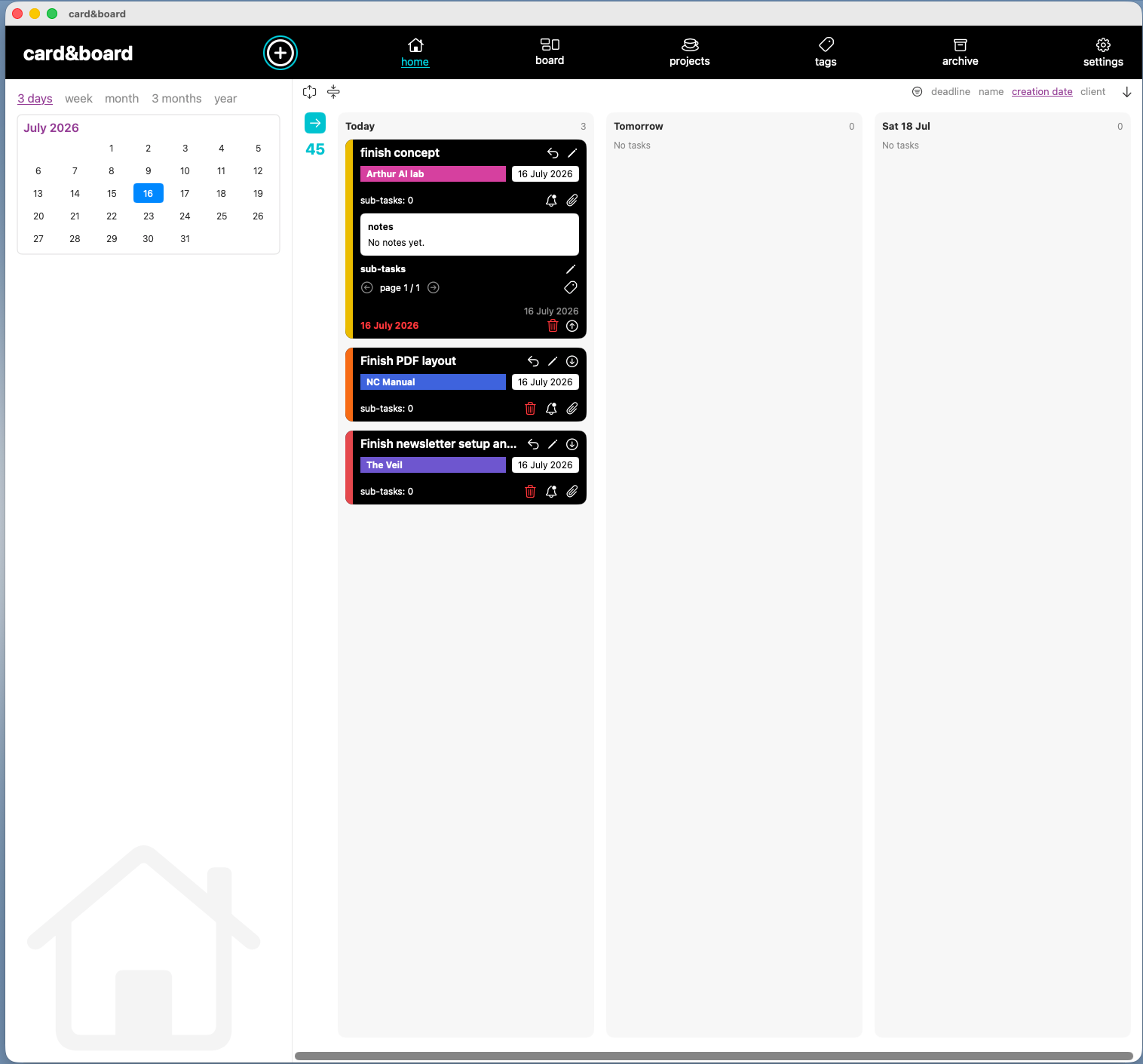
card&board has crossed an important line: it is no longer a prototype waiting for a convincing use case. It is the private shipped app Arthur opens every day to plan the work that builds the other products.
The app brings daily planning, project boards, calendar views, freeform spatial relationships, detailed tasks, files, costs, and long-running projects into one local environment. The point is not to add another generic task manager; it is to let different ways of thinking remain connected without forcing every project into the same view.
Daily use has become the acceptance test. Real deadlines, recurring tasks, notes, project structures, and attachments expose friction faster than demo data ever could. Each irritating pause becomes a design question, and useful changes return immediately to the same real workflow.
AI assistance expanded the implementation capacity, but the product structure, interaction decisions, acceptance criteria, and daily review remain Arthur’s. The app is evidence of an augmented product-design practice precisely because it has to survive ordinary work.
card&board works independently today. Public distribution still needs packaging, signing, licensing, documentation, and support. Its future handoff to cucumber will stay deliberately narrow: card&board knows the project and its costs; cucumber will know the money.