
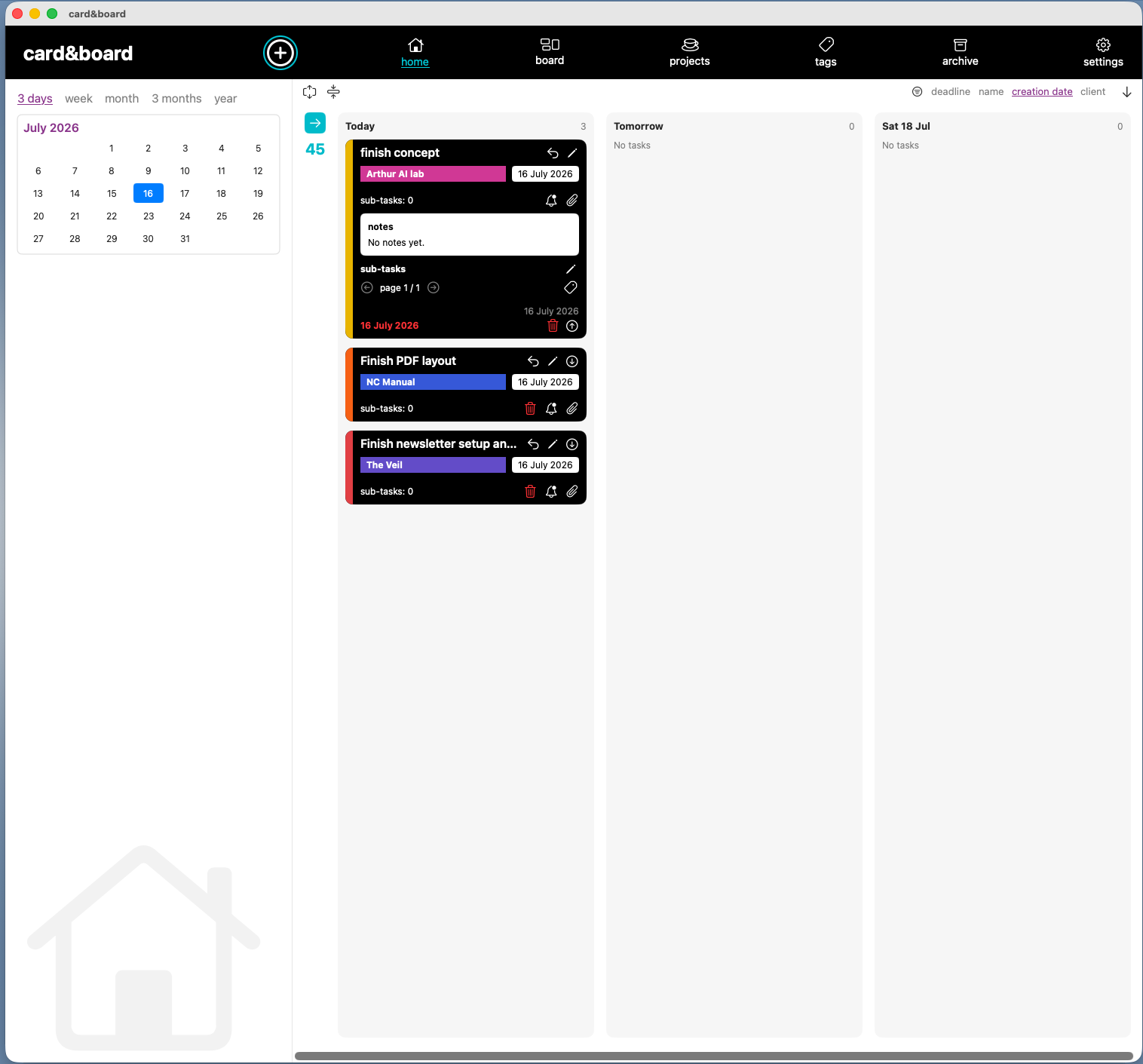
card&board is a native Mac planning app Arthur uses every day. It has already replaced the subscription task manager he used to pay for, although the public commercial release is still being prepared.
The app gives independent work more than one useful shape. A day can be planned on a calendar, a project can be run through lists or a Kanban board, and difficult relationships can be laid out spatially on a freeform canvas. Detailed task cards hold deadlines, priorities, repetition, notes, subtasks, files, and costs without forcing every project into the same view.
The product logic came first. Arthur designed the information model, project hierarchy, interaction patterns, states, constraints, and acceptance standard before implementation began. AI assisted with the SwiftUI production code. Arthur remained responsible for what the app should do, how it should feel, and whether each build was good enough to keep.
This is the practical distinction between vibe coding and augmented product design. card&board was not discovered by prompting until something looked plausible. It was conceived and specified as a product, then implemented, rejected, revised, and tested until it became dependable daily infrastructure.
The app is local-first. Project data remains under the user’s control and does not need to be sent to Arthur or to an AI service. Its deliberately focused interface is also ADHD-friendly: the current context stays visible, actions remain bounded, and the same work can be approached through the view that makes sense at that moment.
card&board will work on its own. It will also form the planning layer of a discounted three-app suite: Aerial View holds the material, card&board plans the work and associates its costs, and cucumber manages the project’s financial completion. Each app remains small, specialized, and independently useful.
Current state: shipped privately and used daily. Public release pending.